
A DTF transfer can arrive ready for production and still develop avoidable problems before it ever reaches the heat press. The period between delivery and application matters because transfers may be exposed to moisture, excessive heat, direct sunlight, folds, dust, or unnecessary handling.
This is particularly worth considering in Delaware, where warm summers, humidity, and year-round precipitation can make uncontrolled spaces less predictable than a normal indoor workspace. For apparel decorators, print shops, and small businesses, DTF transfer storage should therefore be treated as part of production preparation rather than an afterthought.
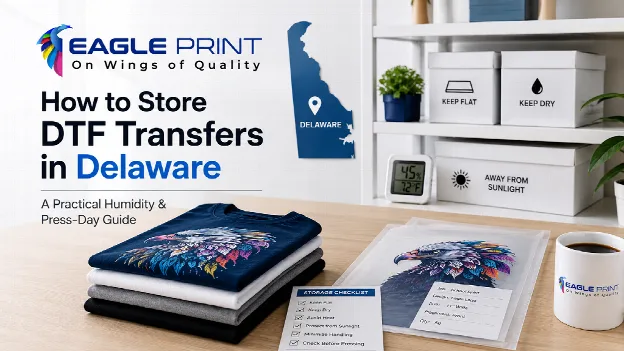
Quick Answer: How Should DTF Transfers Be Stored?
DTF transfers should generally be kept flat, dry, clean, protected from direct sunlight, and away from excessive heat or moisture. Keep them in suitable protective packaging until needed, organize different jobs separately, and inspect each transfer before pressing.
Always follow the specific storage and application instructions provided by your transfer supplier, since recommendations can vary between products.
DTF Transfer Storage Checklist
| Storage Factor | Better Practice | What to Avoid |
| Moisture | Keep transfers in a dry indoor area | Damp garages or exposed storage |
| Temperature | Use a reasonably stable environment | Hot vehicles and direct heat |
| Position | Keep transfers flat and supported | Folding, bending, or crushing |
| Sunlight | Protect from direct light | Sunny windows or exposed surfaces |
| Handling | Handle only when necessary | Repeated contact with the print surface |
| Organization | Separate transfers by job | Mixing unrelated designs together |
Why Storage Matters Before Press Day
DTF transfers are production materials, not ordinary pieces of paper.
A business may receive its transfers several days before blank garments, customer approvals, or production schedules are finalized. During that waiting period, poor storage can introduce variables that were not present when the transfer arrived.
Leaving transfers loose around a workbench, repeatedly moving them between locations, or keeping them in uncontrolled environments offers no production advantage.
A clean indoor office, print room, or production area is generally a more practical staging location than a vehicle, shed, garage, or surface exposed to direct sunlight.
Keep Transfers Protected Until You Need Them
One of the easiest improvements is simply avoiding unnecessary unpacking.
If the garments are not ready for production, keep transfers protected and grouped by job. Opening every package immediately and creating a loose stack of transfers increases the chance of dust exposure, folds, misplaced artwork, or confusion between similar designs.
Businesses sourcing Delaware DTF transfers can make production easier by organizing transfer orders according to the job they belong to.
A simple labeling system might include:
- Customer or project name
- Artwork version
- Transfer dimensions
- Quantity
- Front, back, sleeve, or other placement
This becomes especially useful when the same customer has multiple logo variations or different transfer dimensions within one order.
Store Transfers Flat Instead of Folding Them
Folding a transfer simply to make it fit inside a small drawer creates an unnecessary risk.
Whenever possible, store transfers flat using a folder, protective sleeve, tray, or another system that prevents bending while keeping projects separated.
Avoid putting heavy equipment, garment stacks, or other objects directly on top of loose transfers.
For shops managing multiple jobs, label the outer sleeve or folder rather than repeatedly handling the transfer itself. The objective is simple: when production starts, the correct transfer should be easy to identify and ready to use.
Do Not Use a Parked Vehicle as Long-Term Storage
Vehicles are useful for transportation, but they are not controlled storage environments.
Interior conditions can change significantly, especially during warm weather. Even if a transfer shipment will eventually be transported to another location, leaving it inside a parked vehicle for an extended period introduces an avoidable environmental variable.
The same principle applies to storage areas near heaters, direct sunlight, or spaces that experience significant changes in temperature or humidity.
Once transfers arrive, moving them into the normal indoor production environment is a simple way to reduce unnecessary exposure.
Organize Multiple DTF Jobs Separately
Environmental protection is only one part of good storage. Organization matters too.
Avoid creating one large pile containing transfers for several customers or garments. Even a perfectly stored transfer can create a production error if it is applied to the wrong shirt.
Separate each order according to its production requirements.
If one artwork uses multiple dimensions, clearly identify each size. If a garment needs both front and back graphics, keep those transfers grouped together.
A practical workflow looks like this:
Delivery → Job Identification → Flat Storage → Garment Matching → Press-Day Check → Application
This creates a clear chain from receiving the transfer to decorating the final garment.
Run a Five-Minute Check Before Pressing
Storage should end with a short inspection before production begins.
Before pressing the first garment, confirm:
- The artwork matches the intended garment.
- The transfer is flat, clean, and free from obvious damage.
- The correct transfer dimensions are being used.
- Placement and orientation are confirmed.
- The garment is properly prepared.
- Temperature, time, pressure, and peel instructions are understood.
If the application process itself needs review, this guide on how to apply DTF to shirts covers the practical sequence from garment preparation and positioning through pressing, peeling, and finishing.
Storage and application should be viewed as two connected but different responsibilities.
Storage protects the transfer before production. Correct application determines how that transfer is used on the garment.
Frequently Asked Questions
Can DTF transfers be stored before pressing?
Yes. Transfers can be kept for later production when they are stored according to the supplier’s recommendations. Keeping them flat, dry, clean, and protected is a practical starting point.
Can I store DTF transfers in a garage?
A garage can experience wider changes in temperature and humidity than a normal indoor workspace. If conditions are uncontrolled, a more stable indoor location is generally preferable.
Should DTF transfers be refrigerated?
DTF transfers normally do not need to be treated like refrigerated goods. Follow the instructions for the specific transfers you purchase and prioritize a stable, dry environment without unnecessary heat exposure.
Should different transfer sizes be separated?
Yes. Clearly separating different dimensions helps prevent an operator from choosing the wrong size during production, particularly when the artwork looks similar across several garments.
What should I check after storing a transfer?
Verify the artwork, dimensions, physical condition, placement, garment preparation, and pressing instructions before beginning a production run.
Good Storage Is Really Production Preparation
A useful DTF storage system does not need to be complicated or expensive.
Keep transfers flat, protected, dry, clean, and away from excessive heat or direct sunlight. Separate different customer jobs, minimize unnecessary handling, and inspect the materials before pressing.
For Delaware apparel businesses, this creates a cleaner connection between delivery, storage, organization, and final application.
The benefit is not simply having a neater workspace. A consistent storage process makes it easier for the person operating the heat press to identify the correct artwork, match it with the correct garment, and begin production with fewer avoidable variables.
